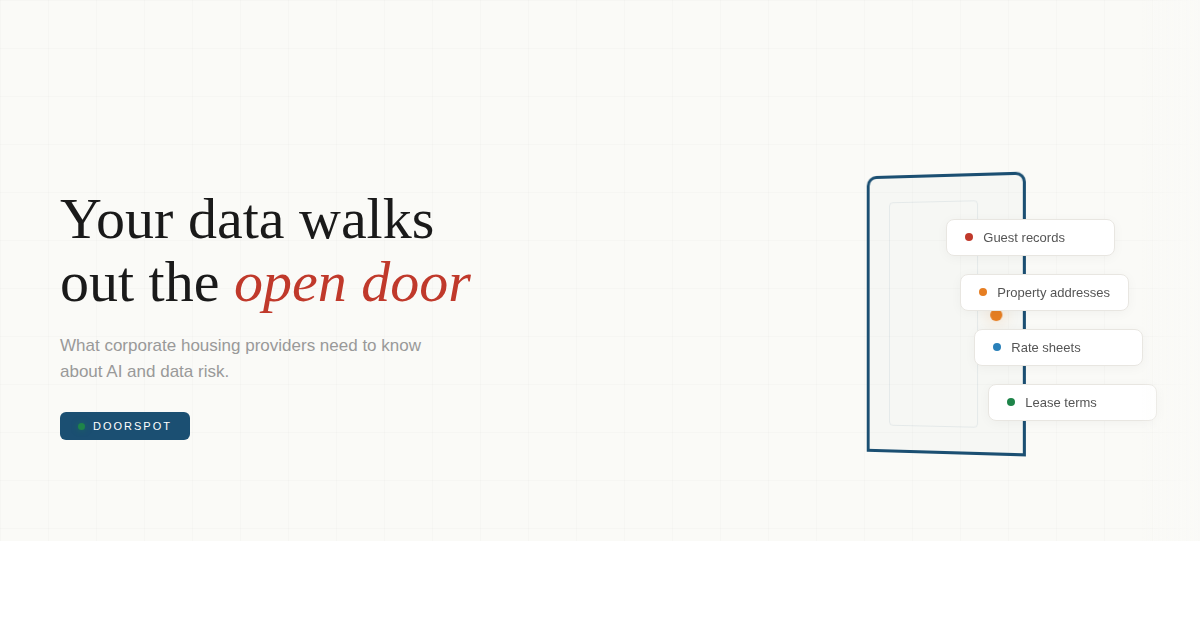
What Corporate Housing Providers Need to Know
February 2026
The Core Issue
AI is increasingly becoming a buzzword and a common, everyday tool in businesses. It is even appearing in corporate housing software, and some platforms are building their entire software around AI. Before adopting any of these tools, it’s worth understanding what happens to your data once it’s exposed to the AI engines.
The short version: many AI systems, without proper precautions, learn from everything you give them. The large AI companies that power these tools can see and may be storing your data. That means your guest information, property addresses, pricing strategies, and booking patterns could be used to improve a system that your competitors also use.
What Data is Actually at Risk
Here’s what a typical corporate housing provider puts into their software on any given day. With AI-first platforms, all of it could be processed by an AI provider. You have to understand your data that could be at risk:
Guest Information
Names, phone numbers, email addresses, employer details, check-in and check-out dates, special requests, and payment information. This is your client’s personal data. In many cases, you have a contractual or legal obligation to protect it. When AI systems have access to, and possibly train on this data, you have no control over where it ends up, who might see it, or who benefits from it.
Property Locations and Details
Your property addresses, unit configurations, amenity lists, photos, and availability calendars. This is your competitive inventory. An AI system that learns your property portfolio, your vacancy patterns, and which units you price at which rates has effectively mapped your business. If that information improves an AI tool used by other providers in your market, you’ve given away information that might help your competitors, using the same AI tool.
Pricing and Business Strategy
Rate sheets, seasonal pricing adjustments, corporate client agreements, and occupancy targets. This is how you make money. When this information is used to train a general AI system, the patterns and strategies you’ve developed over the years can become part of a shared knowledge base.
Vendor and Partner Relationships
Cleaning company contacts, maintenance vendor rates, furniture rental agreements, and utility account details. These relationships took time to build and negotiate. They shouldn’t be data points in someone else’s AI model, and accessible data to anyone using that AI.
| 💡 A Simple Test – Would you hand a printed copy of your guest list, property addresses, and rate sheets to a stranger who also works with your competitors? If not, you should be cautious about which AI tools have access to that same information digitally. |
How This Actually Happens
You don’t have to do anything careless for this to be exposed to these risks. It can happen through normal, everyday use of AI-based tools. Here are four common ways your data gets exposed, each one broader than the last:
Scenario 1: You type it into a chatbot
You open ChatGPT or Claude, paste in a lease agreement, and ask it to summarize the key terms. Or you type “Draft a check-in email for Sarah Johnson arriving March 3rd at 4200 Elm Street, Unit 12B.” Everything you typed—the guest name, the address, the dates—just entered that AI company’s systems. Depending on your AI-use plan and settings, it may be stored for up to several years and used to improve the AI companies models. Your competitor using the same tool benefits from the patterns in your data.
Scenario 2: Your AI assistant pulls from your systems
You’ve connected your AI tool to your property management database through an API or integration. You ask “What’s my occupancy rate for March?” The AI doesn’t just answer from what you typed—it reaches into your database, pulls every property, every booking, every rate for the month, and sends that data to the AI provider’s servers for processing. You asked one simple question. The AI accessed your entire portfolio to answer it. You may never see, or know, exactly what was sent.
Scenario 3: You click an AI button inside your everyday software
Your email tool has a “Draft Reply” button powered by AI. You click it on an email from a corporate client discussing a 50-unit block booking at negotiated rates. The AI reads the entire email thread—client name, company, unit count, pricing, contract terms—and sends it to an AI provider to generate a response. You clicked one button. Your client’s confidential booking terms just left your system.
Scenario 4: The software itself is built around AI
Some newer platforms are designed with AI at the center—every feature, from pricing recommendations to guest communications, runs through an AI engine. In these systems, your entire database is the AI’s working material. Every guest record, every property, every rate sheet is continuously accessible to the AI. You don’t choose what to share; the platform decides what to process. And depending on the AI provider powering it, that data may be subject to training and retention policies you never agreed to directly.
The “Pro Plan” Problem
Most AI companies offer different levels of data protection depending on what you pay them. This distinction matters:
| Enterprise Contracts | Consumer AI Plans (Pro, Plus, Max) | |
| Risk your data trains their AI | None — contractually prohibited | Present — often on by default, opt-out available but easy to miss |
| Data retention | 30 days or less, custom retention available | 30 days minimum, potentially years if training is enabled |
| Who owns the data | You do — clearly stated in the contract | You do — but broader usage rights granted to the provider |
| Cost | $1,000–$5,000+/mo | $20–$200/mo |
Plans labeled “Pro” sound like business-grade protection. They’re consumer products. The real protections—where your data is never used for training—are locked behind enterprise contracts most small businesses can’t afford.
What You Can Do About It
You don’t need to avoid AI entirely. It is an incredibly valuable tool, and you should take advantage of it. But you should know what to ask before trusting any platform with your sensitive business data:
1. “Is my data used to train your AI?” If yes, everything you enter could end up improving a tool your competitors use.
2. “What guest information does your AI process, and where does it go?” If they can’t tell you specifically, that’s a problem.
3. “Are my property addresses visible to the AI system?” Your inventory is your competitive advantage. Know whether it’s being shared.
4. “How long do you keep my data if I leave?” Anything beyond 30 days should concern you.
5. “Can I control exactly what an AI connection can see?” If the answer is no, the vendor controls your data—not you.
Here’s what it looks like when a platform is designed to answer all five of those questions:
| A Note on How DoorSpot Handles This DoorSpot’s core system doesn’t use AI to make decisions. It follows precise, predictable rules. Your data is never used to train any AI model.When you connect an AI tool through our API, you set the exact permissions it can access. If you mark the connection as an AI bot, we automatically strip out guest names, contact information, and property addresses before any data reaches the AI. The tool gets what it needs—booking dates, unit types, rates—without the sensitive details. Every API request is logged, so you always have a record of what was accessed. |
Want to see how it works? Schedule a demo at doorspot.com and we’ll walk you through exactly how DoorSpot’s AI-restricted API keys protect your data—while still giving you the full power of AI tools.